
What the study found.
- Between and , Microsoft Copilot cited digisnax.com 13,500 times across 47 distinct questions, according to the AI Performance report in Bing Webmaster Tools.
- For the question “culver’s flavor of the day,” 38.5% of all sources Copilot cited came from digisnax.com, a site with no brand recognition and almost no inbound links.
- Citation share held between 23.7% and 40.7% across the eight highest-volume questions in the category, so the result is a pattern rather than one lucky query.
- Traditional search moved with it: 122,000 Google impressions in 28 days at an average position of 7.2, improving across every window measured.
Every figure above is first-party reporting on a property DigiSnax operates. The limits of what it proves are stated in full further down this page.
Search stopped returning lists. It started returning answers.
An answer names one source, sometimes two. That answer sits at the top with authority behind it, and most people never scroll past it. They have no reason to. What they were looking for is already there.
Answer engine optimization, or AEO, is the practice of structuring a site so that AI systems cite it when they answer a question. Traditional search engine optimization (SEO) competes for a position in a list of links. Answer engine optimization competes to be the source named inside the answer itself.
Which raises a commercial question with an expensive answer. If a single source gets named, what decides which one? The obvious assumption is brand. The biggest name in a category wins because it is the biggest name.
That assumption looked wrong to us. Our working theory was that answer engines reward something more specific: being the most current, most structured, most complete answer to a recurring question, regardless of who is asking the question about whom.
Authority is something you build, not something you inherit.
That is a testable claim, and a cheap one to test. So we tested it.
Why frozen custard was the right experiment.
A good test needs a question people genuinely ask, an answer that changes constantly, and an incumbent with every structural advantage. Culver’s Flavor of the Day has all three.
For anyone reading this outside the Midwest: Culver’s is a large regional restaurant chain known for burgers and frozen custard, with roughly 1,050 restaurants across 26 states. The Flavor of the Day is the featured custard flavor each restaurant serves, and it is different at each location, every day.
- Real demand. Thousands of people ask what today’s flavor is, every day, without prompting.
- Genuinely local. The flavor differs at every restaurant, so a single answer for the whole chain is useless.
- Perishable by design. Today’s correct answer is wrong tomorrow. Freshness is not a nice-to-have, it is the entire product.
- An incumbent that should win. Culver’s owns the brand, the trademark, the data, the app, and the domain authority. A new site has none of those.
If brand recognition were the deciding factor, the test would fail immediately and we would have learned something cheap and useful. If freshness and structure mattered more, it would show up in the citation data within weeks.
A page for every shape of the question.
The Flavor Finder web app took under a week to develop. It can look up any Culver’s location, and the structure follows how people actually ask rather than how the data happens to be stored.
- A page for every location people ask about. “What is the flavor at the Ripon Culver’s?” Today’s flavor, the next five days, plus address, phone and directions. More than 850 of those pages so far, each added because someone in the audience asked.
- A page for every flavor. “Where can I get Andes Mint Avalanche this week?” That is a different question and it deserves its own answer, not a filtered view of the first one.
- A browsable index of the whole rotation, for people who do not know what they are looking for yet.
- An outbound link to Culver’s own page on every flavor. Sending people to the source is not a leak. It is part of why a system treats you as a reliable place to send them.
- Refreshed daily, on all of it. Every location page and every flavor page is brought current each morning, and has been since launch.
- Nothing clever. No tricks, no manipulation, no attempt to game a ranking system. Just the correct answer, kept correct.
What transfers to any market
The part that transfers is not any single page type. It is that we did not pick one and hope. People ask the same underlying question in at least three shapes, so there is a page built for each shape, and every one of them stays current.
One result genuinely surprised us. The browsable index, the page we thought of as navigation rather than an answer, became the single highest-traffic page on the site by a wide margin. The pages we assumed would carry the work were not the ones that did.
The whole build was done with AI assistance rather than a team. That is a real efficiency story, but it is not the finding. The finding is what happened next.
38.5% of Copilot’s citations, on Culver’s own flagship query.
Citation share is the percentage of all sources an AI system cites for a given question that come from one site. Microsoft added an AI Performance report to Bing Webmaster Tools that reports it, along with how often a property is cited by Copilot and its partners. These are the numbers for the property, first-party and unmodified.
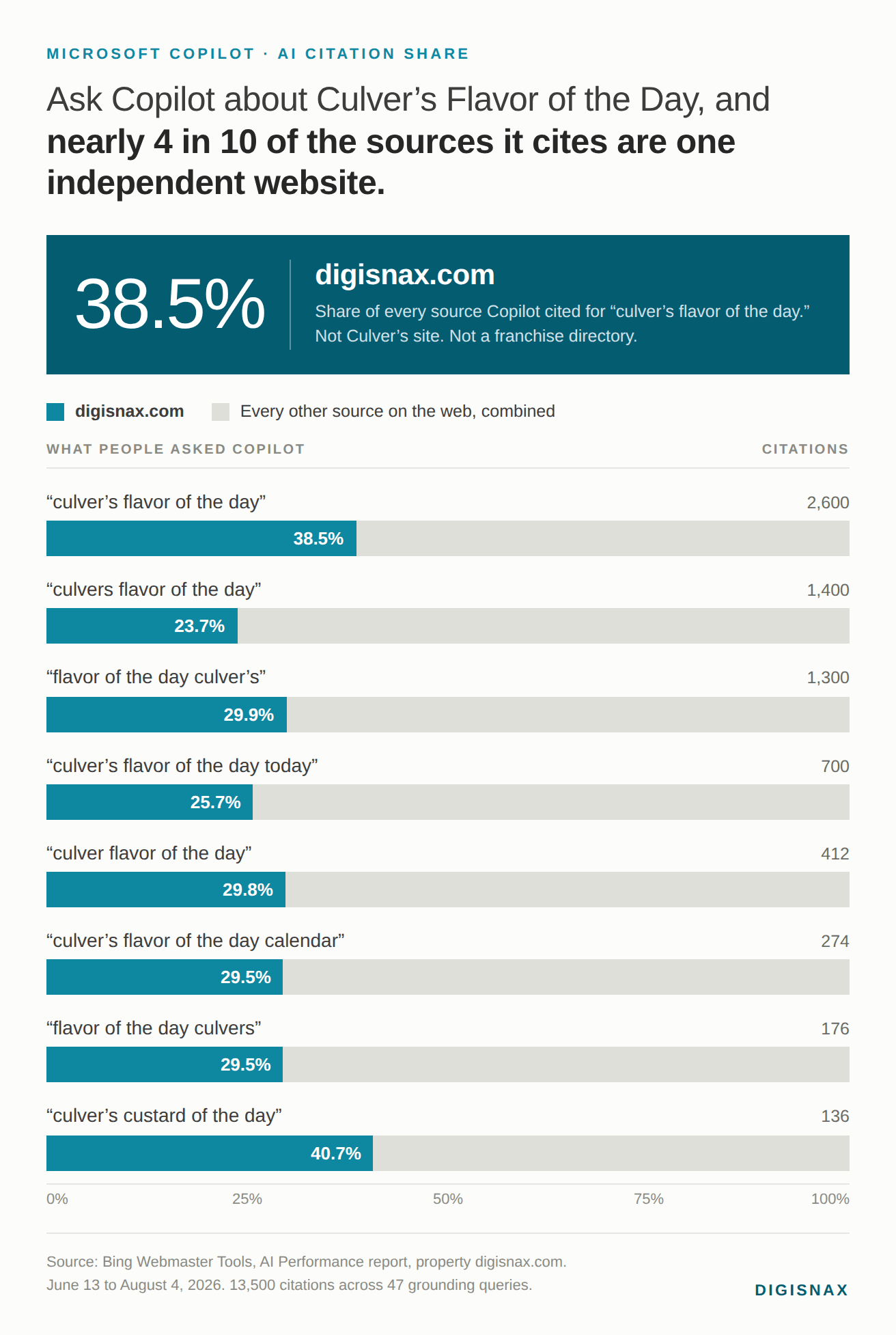
| What people asked Copilot | Citations | Share supplied by digisnax.com |
|---|---|---|
| culver’s flavor of the day | 2,600 | 38.5% |
| culvers flavor of the day | 1,400 | 23.7% |
| flavor of the day culver’s | 1,300 | 29.9% |
| culver’s flavor of the day today | 700 | 25.7% |
| culver flavor of the day | 412 | 29.8% |
| culver’s flavor of the day calendar | 274 | 29.5% |
| flavor of the day culvers | 176 | 29.5% |
| culver’s custard of the day | 136 | 40.7% |
Did traditional search move with it
It did. Over the last 28 days the location pages drew 122,000 impressions at an average position of 7.2 in Google. Average position improved in every window measured: 7.9 across twelve months, 7.7 across three, 7.2 across the most recent month.
These figures describe one live property. Open Flavor Finder and check it against today’s date.
What this does not prove.
Here is where the data stops.
Does this mean DigiSnax outranks Culver’s
No. Citation share reports the portion supplied by digisnax.com. It says nothing about who supplies the remaining 61.5%. Anyone claiming otherwise is reading a number that was not measured.
Is the trend seasonal
Partly, and the season is favorable. August is peak frozen custard demand. The real test is whether these figures hold in February, and that data does not exist yet.
What else the numbers will not carry
- Microsoft labels the report a sample of overall activity, not a census. The proportions are meaningful. The absolute counts are indicative.
- Citations are not traffic. Click-through is low, because Copilot answers the question in the answer. Being the cited source is the outcome being measured here, not visits.
- One category, one test. Frozen custard is a clean experiment precisely because it is simple, and Culver’s is a regional chain rather than a national household name. A housing market is a harder question with more competing sources.
What survives all of that is the part that matters: a property nobody had heard of, with almost nothing linking to it, became a primary source an answer engine reaches for, in weeks, against an incumbent that held every advantage. Authority was built, not inherited.
A neighborhood is the same problem, applied to shelter instead of hunger.
Strip the custard away and the structure underneath is ordinary. A question people ask constantly. An answer that is different in every location. An answer that goes stale quickly. And a set of large incumbents who ought to own it.
That is a real estate market.
“What is the housing market like in Lincoln Park right now?”
“Is this a good time to sell in Wilmette?”
“Does Barrington have good public schools?”
Those questions are put to AI thousands of times a day, and one website is going to be the answer. The difference now is that the answer arrives before anyone clicks anything.
The Flavor Finder web app took under a week to develop. The DigiSnax Real Estate Authority Platform took over three months, and it keeps evolving with client use. It runs the same architecture for agents and teams: a page for every neighborhood served, kept current every month, structured to answer the questions buyers and sellers actually ask. One agent per neighborhood, so the authority being built is not being built for a competitor at the same time.
None of the method is a secret. This page sets it out, and anyone willing to do the work could follow it. The part DigiSnax keeps is the platform that runs it at scale: the structure, the data work, and the monthly freshness, handled on the agent’s behalf.